Printed Battery Market Set for 40.12% CAGR as Healthcare Wearables and IoT Applications Expand
Global Printed Battery Market to Reach USD 3,545.81 Million by 2032 as Wearable Electronics, Healthcare Innovation and IoT Adoption Accelerate
Printed Battery Market Expands at 40.12% CAGR Through 2032, Creating New Opportunities in Flexible Energy Storage, Smart Packaging, Medical Devices and Next-Generation Electronics
The global Printed Battery Market is emerging as an important segment of advanced energy storage technology as manufacturers seek thinner, lighter and more adaptable power solutions for connected electronic devices. Growing demand for wearable healthcare technology, intelligent sensors, smart packaging and Internet of Things (IoT) applications is encouraging the development of printed batteries that integrate directly into electronic products.
According to Maximize Market Research, the Global Printed Battery Market was valued at USD 334.36 Million in 2025 and is projected to reach USD 3,545.81 Million by 2032, expanding at a CAGR of 40.12% during 2026–2032.
This projected expansion reflects the increasing importance of compact energy storage in electronic systems where conventional rigid batteries can limit product design and functionality.
Printed battery technology creates opportunities for manufacturers to develop flexible devices, simplify electronic integration and explore scalable production methods. However, successful commercialization requires improvements in energy density, manufacturing consistency, battery safety and long-term reliability.
𝐃𝐨𝐰𝐧𝐥𝐨𝐚𝐝 𝐏𝐃𝐅 𝐁𝐫𝐨𝐜𝐡𝐮𝐫𝐞 @
https://www.maximizemarketresearch.com/request-sample/190190/
Printed Battery Market Overview: Flexible Power Solutions Reshape Electronics Manufacturing
Printed batteries are energy storage devices manufactured through printing techniques that deposit functional materials onto suitable substrates. These processes allow battery components to be produced in thin, lightweight and potentially flexible formats.
Unlike conventional battery designs, printed batteries can support applications where limited space, low weight and product flexibility are important engineering requirements.
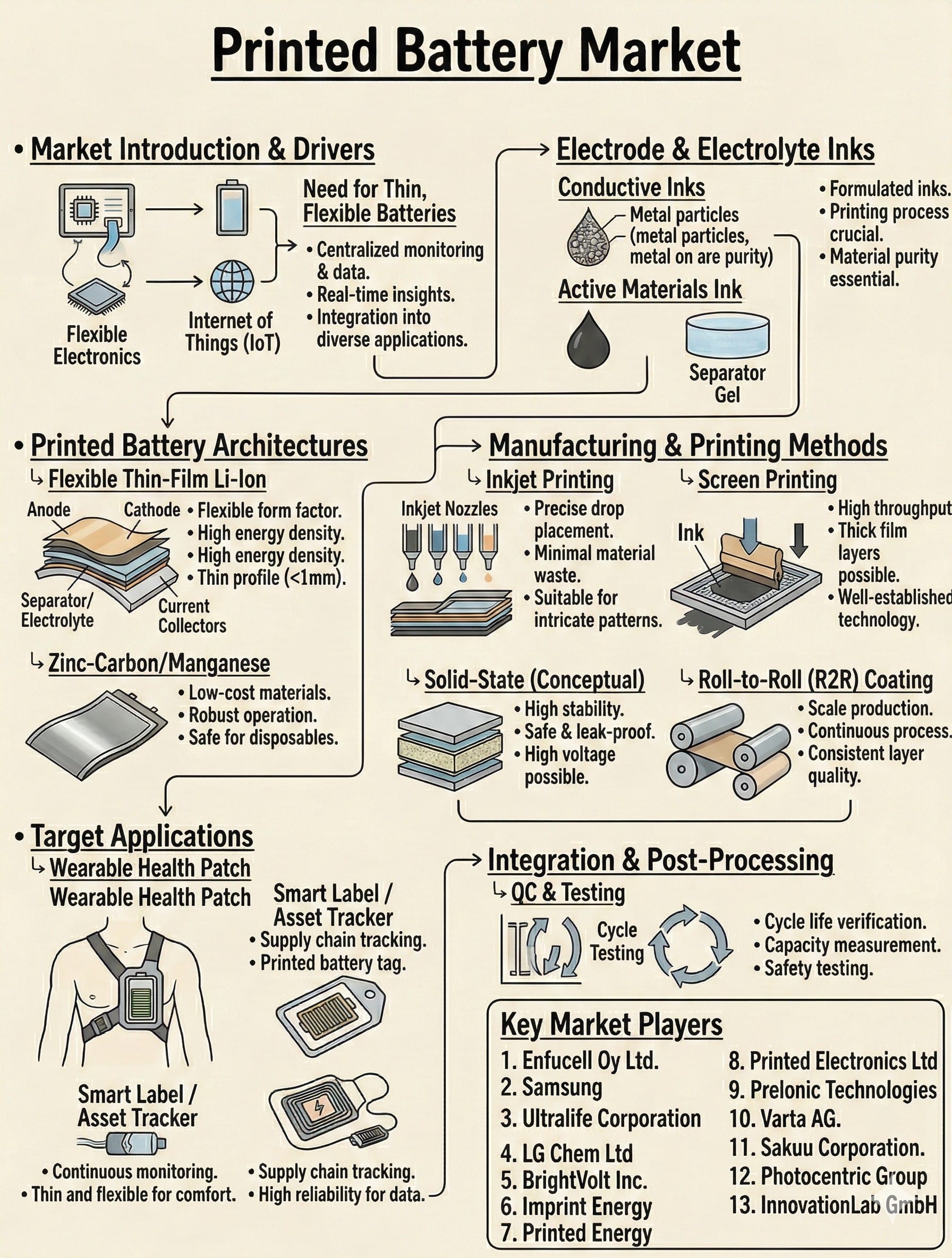
Printing technologies such as screen printing, inkjet printing and flexographic printing create opportunities for integrating power sources into labels, wearable patches, sensors and other electronic products.
The Printed Battery Market is increasingly connected to the development of printed electronics, flexible circuits and intelligent connected devices.
Manufacturers are exploring ways to combine power generation, energy storage and electronic functionality within compact product structures.
For businesses, the technology offers an opportunity to develop products that are difficult to manufacture using traditional battery configurations.
The next stage of market development depends on achieving reliable performance at commercially competitive production costs.
Healthcare and Wearable Medical Devices Drive Printed Battery Market Growth
Healthcare represents an important opportunity for printed battery manufacturers as medical technology moves toward wearable monitoring, connected diagnostics and patient-focused electronic devices.
Flexible medical patches, biometric monitoring sensors and portable diagnostic systems require compact power sources that support comfortable product design.
Printed batteries can provide suitable energy solutions for selected low-power medical applications, depending on device specifications and required operating life.
The growing adoption of remote patient monitoring creates opportunities for electronics manufacturers, battery developers and healthcare technology companies to collaborate.
Medical device manufacturers increasingly prioritize lightweight components, dependable energy performance and product designs that support patient comfort.
Printed battery suppliers entering healthcare applications must also address regulatory requirements, material safety, reliability testing and product qualification.
These requirements make healthcare a commercially attractive but technically demanding market.
Companies that establish validated manufacturing processes and strong partnerships with medical device developers can improve their positioning in specialized healthcare applications.
IoT Expansion Creates New Demand for Printed Battery Technology
The expanding Internet of Things ecosystem is creating opportunities for energy storage solutions designed for low-power connected devices.
Industrial sensors, intelligent labels, environmental monitoring equipment and wireless identification systems require dependable power sources that can operate within compact designs.
Printed batteries are particularly relevant where flexibility, thinness and integration with printed electronic circuits offer practical benefits.
In industrial environments, connected sensors support equipment monitoring, operating efficiency and data collection.
Smart buildings and logistics networks also create opportunities for distributed sensing technologies.
For manufacturers, IoT applications provide a path toward recurring demand as businesses deploy connected devices across multiple locations.
However, battery selection depends on operating temperature, communication frequency, energy consumption and expected service life.
Printed battery developers must demonstrate that their products meet these application-specific requirements.
The ability to provide predictable performance at scale will be essential for converting technology demonstrations into sustained commercial orders.
Printed Battery Market Trends: Advanced Materials and Printing Innovation Support Commercialization
Innovation in battery materials and manufacturing methods is shaping the industry's competitive direction.
Research into printable electrodes, solid-state electrolytes and flexible substrates aims to improve battery performance while maintaining thin and adaptable designs.
Screen printing remains an important manufacturing approach because it supports the controlled deposition of functional materials.
Inkjet printing offers opportunities for precise material placement, while other printing methods may support higher-throughput production depending on product requirements.
Rechargeable printed battery technologies are also attracting interest for applications requiring repeated energy use.
Developers are exploring improved electrode formulations, encapsulation systems and production techniques to strengthen performance consistency.
Another important trend involves integrating printed batteries directly into electronic products rather than treating them as separate components.
This approach creates opportunities for electronics manufacturers to redesign devices around smaller and more flexible power systems.
Commercial progress will depend on manufacturing yield, product durability and the ability to maintain consistent performance across production batches.
Printed Battery Market Segment Analysis: Anode Technology Holds a Leading Position
Anode Components Remain Important to Battery Performance
According to Maximize Market Research, the anode segment holds the largest share of the Printed Battery Market by component.
Anodes play a critical role in battery operation and influence energy capacity, material compatibility and overall electrochemical performance.
Research into specialized electrode materials creates opportunities for improved battery configurations.
Manufacturers are developing material combinations that balance energy performance, flexibility and printing compatibility.
Cathodes, electrolytes and current collectors are also essential components, with each influencing the reliability and cost of the finished battery.
Radio-Frequency Sensing and Data Recording Offer Application Opportunities
The report categorizes applications into radio-frequency sensing, data recording systems and other applications.
Printed batteries can support connected identification technologies where compact power sources enable additional sensing or data-processing functions.
Data recording systems also create demand for thin energy storage solutions in monitoring and tracking applications.
The commercial potential of each application depends on power requirements, production economics and integration with electronic components.
Healthcare, Wearables and Consumer Electronics Broaden End-Use Demand
The report identifies consumer electronics, wearable devices, pharmaceuticals and healthcare, packaging and related applications as important end-use categories.
Wearable products benefit from lightweight power components that support compact and flexible designs.
Smart packaging applications create opportunities for temperature monitoring, product identification and shipment-condition tracking.
Consumer electronics manufacturers are exploring printed batteries for specialized devices where conventional battery geometry presents design limitations.
This diversified application base supports opportunities across several industries rather than dependence on a single end-user segment.
Printed Battery Market Regional Analysis: North America Leads Future Opportunities
North America Benefits from Technology Development and Healthcare Innovation
Maximize Market Research identifies North America as the region expected to dominate the Printed Battery Market during the forecast period.
The United States offers a strong environment for printed battery innovation through advanced electronics development, healthcare technology and industrial IoT applications.
Research activities and commercial interest in wearable electronics contribute to the region's market potential.
Partnerships between material developers, electronic device manufacturers and healthcare technology companies can support commercialization.
Europe Focuses on Sustainable Electronics and Advanced Materials
Europe represents an important market for printed battery research, flexible electronics development and material innovation.
Germany, France, the United Kingdom and other European countries provide opportunities across industrial sensors, healthcare electronics and advanced manufacturing.
Regional interest in resource efficiency encourages investigation into alternative battery chemistries and production processes.
Manufacturers must nevertheless demonstrate environmental benefits through credible material and lifecycle assessments.
Asia Pacific Offers Manufacturing and Electronics Integration Opportunities
Asia Pacific has significant potential because of its electronics manufacturing infrastructure and expanding connected-device applications.
China, Japan and South Korea contribute technological expertise and manufacturing capabilities relevant to printed electronics.
India presents opportunities in electronics manufacturing, healthcare devices and industrial digitalization.
Regional suppliers capable of integrating printed batteries into established electronics production networks may improve manufacturing scale and cost competitiveness.
Emerging Regions Present Longer-Term Opportunities
South America and the Middle East and Africa offer developing opportunities associated with connected devices, healthcare technology and industrial monitoring.
Market entry strategies should prioritize local customer needs, distribution partnerships and practical application requirements.
Competitive Landscape: Printed Battery Manufacturers Focus on Technology Differentiation
The Printed Battery Market includes specialized battery developers, advanced material companies and established electronics manufacturers.
Companies profiled in the Maximize Market Research report include Enfucell Oy Ltd., Samsung, Ultralife Corporation, LG Chem Ltd., BrightVolt Inc., Imprint Energy, Printed Energy, Printed Electronics Ltd., Prelonic Technologies, VARTA AG, Sakuu Corporation, Photocentric Group and InnovationLab GmbH.
Competition increasingly centers on technical performance, product flexibility, manufacturability and integration capabilities.
Enfucell's wearable temperature-monitoring technology demonstrates how printed battery solutions can support connected healthcare-related applications.
Imprint Energy's printed battery technology illustrates opportunities in intelligent logistics labels and environmental monitoring.
These examples highlight a broader shift toward supplying application-ready energy solutions instead of standalone battery components.
Manufacturers capable of supporting device design, technical qualification and scalable production can strengthen their relationships with industrial customers.
Printed Battery Market Challenges: Energy Density and Manufacturing Reliability Require Attention
Despite strong growth projections, printed batteries face technical and commercial barriers.
Energy density remains a significant limitation when compared with conventional battery technologies designed for higher-capacity applications.
This restricts adoption in products requiring substantial energy storage or prolonged high-power operation.
Manufacturing consistency is another important consideration because variations in printed layers can influence battery performance.
Developers must also address encapsulation, environmental stability and reliable operation under real-world conditions.
Production economics become increasingly important as companies transition from research-scale output to commercial manufacturing.
Businesses evaluating printed batteries must compare total system costs, product lifetime and qualification requirements against established alternatives.
These challenges reinforce the importance of focused application selection and disciplined investment decisions.
Investment Opportunities: Commercial Partnerships and Scalable Production Create Business Value
The projected expansion of the Printed Battery Market creates investment opportunities in printable battery materials, manufacturing equipment and specialized electronic applications.
Healthcare wearables and intelligent packaging offer attractive development areas because compact energy storage can provide identifiable functional benefits.
Industrial IoT applications create additional opportunities where wireless sensing and flexible device integration are commercially valuable.
Investors should evaluate technology readiness, intellectual property, production capabilities and customer qualification progress before committing capital.
Partnerships between battery innovators and established electronics manufacturers can help reduce commercialization risks.
Licensing arrangements, specialized manufacturing services and integrated component supply represent possible business models.
Companies that secure repeatable production processes and dependable customer demand can build more sustainable competitive positions.
Strategic Business Decisions: Printed Battery Commercialization Requires Application-Focused Planning
Printed battery manufacturers should prioritize applications where their technology provides clear advantages over conventional batteries.
Product developers need to match battery specifications with energy demand, required operating life, flexibility and environmental conditions.
Electronics companies should evaluate whether printed batteries simplify product assembly or enable new device capabilities.
Medical device manufacturers must prioritize validation, safety and regulatory compliance.
Industrial customers should assess operating reliability, replacement requirements and total ownership costs.
For investors and technology suppliers, the most important decision is identifying commercially practical applications rather than pursuing every emerging electronics opportunity.
A focused commercialization strategy can improve development efficiency, customer confidence and long-term profitability.
Future Outlook: Printed Batteries Enable the Next Generation of Connected Electronics
The future of the Printed Battery Market is closely linked to the expansion of flexible electronics, connected healthcare devices and intelligent industrial systems.
Advancements in materials, printing techniques and battery integration are expected to create additional design possibilities.
Growing interest in smart labels, compact sensors and wearable technology provides potential pathways for commercial expansion.
However, market success will require improvements in energy performance, manufacturing consistency and production economics.
The strongest opportunities are likely to emerge where printed battery technology solves clearly defined product-design challenges.
Manufacturers that combine technical innovation with application expertise and scalable manufacturing capabilities will be better positioned to capture future demand.
Analyst Perspective: Printed Battery Technology Moves Toward Commercial Value Creation
The Printed Battery Market represents a developing opportunity at the intersection of advanced materials, electronics manufacturing and compact energy storage.
According to the Maximize Market Research forecast, the market's projected 40.12% CAGR through 2032 reflects expectations for growing adoption across multiple applications.
Nevertheless, successful companies will distinguish themselves through measurable performance rather than technological novelty alone.
Healthcare, connected sensing and intelligent packaging offer opportunities where lightweight and flexible power systems can improve product functionality.
For manufacturers, investment priorities should include material development, quality assurance, equipment compatibility and commercial partnerships.
For end users, decisions should focus on practical benefits, reliability and lifecycle economics.
Printed batteries have the potential to enable new categories of electronic products, but commercialization discipline will determine which innovations achieve durable market adoption.
𝐃𝐨𝐰𝐧𝐥𝐨𝐚𝐝 𝐏𝐃𝐅 𝐁𝐫𝐨𝐜𝐡𝐮𝐫𝐞 @
https://www.maximizemarketresearch.com/market-report/printed-battery-market/190190/
About Maximize Market Research
Maximize Market Research publishes sector forecasts, competitive analysis, and consulting insight for teams evaluating demand, competition, pricing, and growth strategy across high-value industries.
The company delivers market intelligence across electronics, semiconductors, advanced materials, healthcare, energy storage, industrial automation and emerging technologies.
Its Printed Battery Market research examines market forecasts, technology trends, components, applications, end-use industries, regional opportunities and competitive developments.
These insights support manufacturers, investors and business leaders evaluating product innovation, market entry, strategic partnerships and long-term investment decisions.
Contact Information
MAXIMIZE MARKET RESEARCH PVT. LTD.
2nd Floor, Navale IT Park Phase 3
Pune Banglore Highway, Narhe
Pune, Maharashtra 411041, India
Phone: +91 9607365656
Email: sales@maximizemarketresearch.com
Website: https://www.maximizemarketresearch.com/
Read the Full Printed Battery Market Report:
https://www.maximizemarketresearch.com/market-report/printed-battery-market/190190/