Optical Emission Spectroscopy Market to Hit USD 1.45 Billion by 2034 as Precision Testing Demand Rises
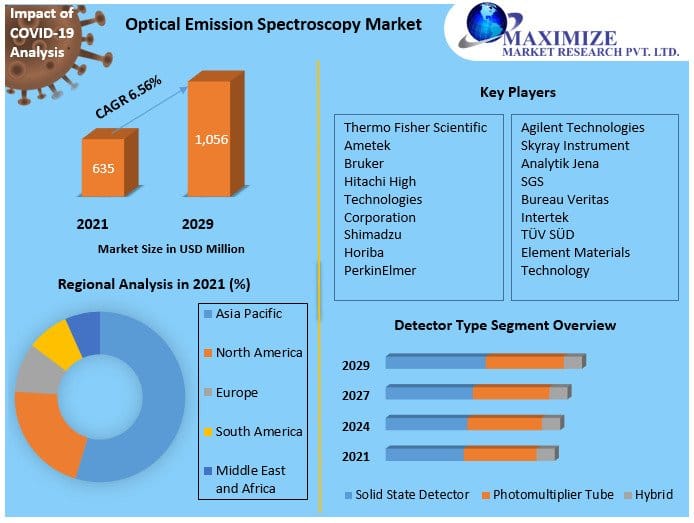
Optical Emission Spectroscopy Market to Reach USD 1,451 Million by 2034 at 6.56% CAGR as Precision Testing and Industrial Quality Control Accelerate
Rising demand for elemental analysis, advanced laboratory equipment, automated metal testing, and material quality verification creates strategic growth opportunities for spectroscopy manufacturers, testing laboratories, and industrial technology providers worldwide.
Maximize Market Research presents its latest strategic analysis of the global Optical Emission Spectroscopy Market, highlighting the increasing importance of accurate elemental analysis across manufacturing, metallurgy, automotive, aerospace, environmental testing, and laboratory applications.
The market, valued at USD 819.07 Million in 2025, is projected to reach USD 1,451.00 Million by 2034, registering a CAGR of 6.56% from 2026 to 2034.
Increasing industrial quality requirements, manufacturing modernization, advanced analytical technologies, and demand for reliable material identification support long-term market expansion.
Industrial organizations increasingly recognize optical emission spectroscopy as an essential technology for maintaining product consistency, verifying material composition, and reducing production-related risks.
The research identifies opportunities for analytical instrument manufacturers, laboratory service providers, industrial equipment suppliers, and investors seeking exposure to precision measurement and quality assurance technologies.
𝐃𝐨𝐰𝐧𝐥𝐨𝐚𝐝 𝐏𝐃𝐅 𝐁𝐫𝐨𝐜𝐡𝐮𝐫𝐞 @ https://www.maximizemarketresearch.com/request-sample/64484/
Optical Emission Spectroscopy Becomes Essential to Industrial Material Analysis
Optical Emission Spectroscopy, commonly known as OES, is an analytical technique used to identify and quantify elements by measuring characteristic light emitted from excited atoms and ions.
The technology uses excitation sources such as electrical sparks or inductively coupled plasma to generate optical emission from sample materials.
Each element produces characteristic spectral lines, allowing analytical instruments to determine elemental composition.
This capability makes OES valuable for examining metals, alloys, industrial raw materials, chemical samples, and environmental specimens.
Manufacturers use elemental analysis to confirm material specifications, monitor production consistency, and identify unwanted impurities.
The technology's commercial significance extends beyond laboratory testing because reliable material verification supports product quality, regulatory compliance, and manufacturing efficiency.
As industrial processes become more sophisticated, demand increases for analytical systems offering dependable performance, faster testing, and consistent measurement results.
Advanced Manufacturing Strengthens Demand for Accurate Elemental Testing
Manufacturing industries increasingly require precise information about raw material composition and finished product quality.
Variations in elemental composition can affect mechanical performance, durability, corrosion resistance, and product reliability.
Optical emission spectroscopy provides manufacturers with analytical information needed to verify materials against established specifications.
Metal producers, component manufacturers, and industrial laboratories use spectroscopy to assess material consistency during production.
Rapid analysis allows quality teams to identify potential deviations before materials proceed through additional manufacturing stages.
This approach reduces the risk of defective products, unnecessary processing, and costly production interruptions.
For analytical equipment suppliers, manufacturing modernization creates opportunities through instrument upgrades, automated testing solutions, calibration services, and technical support contracts.
Metal Production and Heavy Machinery Create Strong Commercial Opportunities
Metallurgy represents an important application area for optical emission spectroscopy.
Steel producers, aluminum processors, foundries, and specialty alloy manufacturers require reliable elemental composition analysis.
Spark optical emission spectroscopy is particularly suitable for examining many solid conductive metal samples.
The technique supports alloy identification, process monitoring, and verification of material specifications.
Industrial manufacturers increasingly seek analytical instruments capable of delivering results within demanding production schedules.
Accurate testing is particularly important when materials serve high-performance applications requiring tightly controlled chemical composition.
For equipment manufacturers, the commercial opportunity involves supplying durable instruments, automated analysis software, and dependable maintenance services.
Manufacturers that integrate spectroscopy into production quality systems can improve inspection consistency and support informed operational decisions.
Automotive Manufacturing Supports Quality Inspection Requirements
Automotive manufacturers require reliable material identification across engines, structural components, transmissions, and specialized metal assemblies.
Elemental analysis helps verify alloy composition and supports quality management throughout automotive supply chains.
Increasing vehicle complexity creates additional requirements for material consistency and production traceability.
Electric vehicle manufacturing also introduces applications involving lightweight components, specialized alloys, and selected battery-related materials.
Automotive suppliers increasingly evaluate analytical equipment according to testing accuracy, throughput, operating costs, and compatibility with manufacturing workflows.
Optical emission spectroscopy supports material verification where accurate elemental information is essential.
For testing equipment providers, opportunities emerge through automotive quality laboratories, production facilities, and specialized inspection services.
Aerospace and Defense Prioritize Reliable Material Verification
Aerospace and defense manufacturers depend on accurate material analysis because component integrity is essential to operational safety.
Aircraft structures, turbine components, propulsion systems, and precision-engineered assemblies require materials that meet demanding technical specifications.
Optical emission spectroscopy supports verification of metallic alloys and identification of selected trace elements.
Advanced manufacturing facilities increasingly combine analytical testing with documented quality procedures.
These practices help manufacturers maintain consistent production standards and identify unsuitable materials.
Aerospace suppliers also require dependable calibration, testing documentation, and technical service support.
For spectroscopy companies, competitive differentiation depends on analytical performance, reproducibility, qualified service personnel, and long-term equipment reliability.
Inductively Coupled Plasma Technology Expands Laboratory Applications
Based on excitation source, the market includes Inductively Coupled Plasma and Spark.
Inductively Coupled Plasma Optical Emission Spectroscopy, or ICP-OES, uses high-temperature plasma to excite atoms and ions for elemental measurement.
The technique supports multi-element analysis across appropriately prepared liquid samples.
Applications include environmental testing, chemical analysis, industrial quality assurance, and laboratory research.
ICP-OES can provide efficient sample throughput and suitable detection capabilities for many elemental testing requirements.
Spark OES remains important in metal manufacturing because it allows direct analysis of suitable solid samples.
Each technology serves different analytical requirements.
Commercial opportunities therefore depend on supplying instruments suited to specific samples, detection limits, laboratory workloads, and operating environments.
Solid State Detectors Strengthen Modern Spectroscopy Equipment
By detector type, the market covers Photomultiplier Tube, Solid State Detector, and Hybrid technologies.
The solid state detector segment is expected to hold the largest market share by 2034.
Solid state optical detectors support simultaneous measurement across multiple wavelengths, helping instruments acquire detailed spectral information.
Their capabilities contribute to compact instrument design and efficient analytical processing.
Photomultiplier tubes remain valuable in applications requiring sensitive detection of low light intensities.
Hybrid configurations combine selected detector characteristics to address specialized measurement requirements.
Manufacturers increasingly focus on improving detector performance, signal processing, operational reliability, and analytical flexibility.
For instrument buyers, appropriate detector selection depends on application requirements, measurement sensitivity, instrument design, and total ownership costs.
Equipment and Services Develop Complementary Revenue Opportunities
Based on offering, the market is divided into Equipment and Services.
Equipment includes optical emission spectrometers and related analytical instrumentation used in industrial and laboratory environments.
Manufacturers compete through measurement precision, instrument durability, testing speed, software functionality, and operating efficiency.
Services include equipment maintenance, calibration, technical support, laboratory analysis, and specialized testing activities.
Industrial customers increasingly evaluate the availability of qualified service personnel before purchasing advanced analytical instruments.
Reliable maintenance support helps minimize instrument downtime and maintain consistent testing performance.
For spectroscopy suppliers, combining equipment sales with calibration and long-term service agreements can strengthen recurring revenue.
Specialized laboratories also benefit from manufacturers that outsource selected analytical requirements rather than establishing extensive in-house facilities.
Environmental Monitoring Increases Demand for Elemental Analysis
Environmental laboratories use elemental analysis to evaluate samples associated with water quality, soil conditions, industrial emissions, and contamination assessment.
ICP-OES provides capabilities for measuring multiple elements in suitably prepared environmental samples.
Industrial organizations increasingly require dependable analytical information to support environmental management and regulatory reporting.
Municipal authorities, testing laboratories, and industrial facilities represent potential customers for advanced analytical systems.
Sample preparation, analytical validation, and quality assurance remain essential to obtaining reliable results.
For technology providers, environmental testing creates opportunities through specialized equipment, laboratory automation, and technical training.
Growth potential depends on regional testing requirements, laboratory investment, and the availability of qualified analytical personnel.
Food and Beverage Laboratories Expand Precision Testing Applications
The food and beverage sector represents another application area for optical emission spectroscopy.
Laboratories use elemental analysis to evaluate mineral content and selected contaminants in food ingredients and finished products.
Consistent analytical testing supports product quality and compliance with applicable food safety requirements.
Food manufacturers increasingly evaluate laboratory technologies that offer accurate multi-element analysis and manageable operating costs.
Modern analytical systems can improve testing workflows while reducing repetitive laboratory procedures.
However, dependable results require suitable sample preparation, calibrated instruments, and validated methods.
For spectroscopy suppliers, opportunities emerge through food testing laboratories, research facilities, and specialized quality assurance services.
Asia Pacific Leads Global Optical Emission Spectroscopy Demand
Asia Pacific is expected to dominate the Optical Emission Spectroscopy Market during the forecast period.
China remains an important demand center through extensive metal production, industrial manufacturing, and laboratory testing activities.
India offers opportunities through infrastructure expansion, automotive manufacturing, metallurgy, and increasing industrial quality requirements.
Japan and South Korea contribute through advanced manufacturing, electronics, automotive engineering, and analytical technology development.
Australia supports demand through mining, mineral processing, and environmental laboratory applications.
The region's industrial expansion creates opportunities for spectroscopy equipment manufacturers and specialized service providers.
Successful market participation requires competitive pricing, dependable distribution, customer training, and accessible technical support.
North America Supports Advanced Analytical Equipment Adoption
North America represents an important market supported by established research infrastructure and demanding industrial quality requirements.
The United States contributes through aerospace manufacturing, automotive production, environmental testing, and advanced laboratory operations.
Canada supports analytical equipment demand through mining, metallurgy, energy, and industrial research applications.
Mexico provides opportunities through automotive manufacturing and expanding industrial supply chains.
Regional laboratories increasingly assess equipment according to measurement performance, service availability, and integration with digital laboratory systems.
The presence of established analytical instrument manufacturers also supports technology development.
For market participants, recurring service contracts and laboratory modernization create attractive commercial opportunities.
Europe Emphasizes Precision Engineering and Laboratory Modernization
Europe maintains an important position through its advanced industrial manufacturing and analytical technology capabilities.
Germany contributes through automotive engineering, precision manufacturing, metallurgy, and industrial equipment production.
France, the United Kingdom, and Italy support demand across aerospace, chemicals, laboratory research, and specialized manufacturing.
European industrial customers increasingly prioritize reliable analytical results, documented quality procedures, and equipment efficiency.
Environmental testing requirements also influence laboratory investment decisions.
Manufacturers serving Europe benefit from developing systems that combine analytical performance with dependable calibration and service support.
Opportunities additionally emerge through modernization of established laboratories and replacement of aging analytical equipment.
Middle East, Africa and South America Offer Selective Growth Opportunities
The Middle East presents opportunities through oil and gas operations, petrochemical processing, metal manufacturing, and industrial laboratory development.
African economies support demand through mining, mineral processing, environmental testing, and infrastructure-related materials analysis.
South America contributes through metallurgy, industrial manufacturing, and mining activities.
Brazil remains an important regional market for industrial testing equipment.
Market development depends on industrial investment, laboratory infrastructure, technical training, and instrument affordability.
Suppliers entering these markets require effective distribution arrangements and dependable service networks.
Partnerships with local laboratories and industrial organizations can support long-term market development.
Competitive Landscape Focuses on Analytical Performance and Service Reliability
The market includes established analytical instrument manufacturers, testing organizations, and specialized spectroscopy technology providers.
Key companies identified by Maximize Market Research include Thermo Fisher Scientific, AMETEK, Bruker, Hitachi High Technologies Corporation, Shimadzu, HORIBA, PerkinElmer, Agilent Technologies, Skyray Instrument, Analytik Jena, SGS, Bureau Veritas, Intertek, TÜV SÜD, Element Materials Technology, SPECTRO Analytical Instruments, Teledyne Leeman Labs, and Focused Photonics.
These organizations participate across analytical equipment, testing services, and laboratory technologies.
Competition increasingly depends on detection performance, testing efficiency, instrument reliability, application expertise, and technical support.
Companies offering integrated analytical solutions and dependable lifecycle services can strengthen customer relationships.
Automation and Digital Integration Improve Laboratory Productivity
Laboratories increasingly evaluate automated sample handling, digital reporting, and connected analytical systems.
Software integration helps laboratories organize measurement data, maintain testing records, and improve workflow consistency.
Automated analysis functions can reduce repetitive tasks and support faster interpretation of spectral information.
Advanced data processing technologies also create opportunities for improving spectral evaluation and quality monitoring.
However, laboratories must maintain appropriate validation procedures and qualified technical oversight.
Equipment manufacturers that connect analytical performance with practical workflow improvements can strengthen their competitive positions.
High Equipment Costs and Skilled Workforce Requirements Influence Adoption
Optical emission spectroscopy systems require investment in equipment, calibration, maintenance, and trained personnel.
Advanced instruments can involve substantial initial expenditure, particularly for smaller laboratories and industrial facilities.
Operating costs also depend on sample preparation, consumables, analytical workload, and technical support.
A shortage of qualified personnel can create challenges for organizations introducing sophisticated analytical technologies.
Manufacturers can address these barriers through training programs, simplified operating interfaces, flexible service arrangements, and reliable maintenance support.
For customers, equipment selection should balance analytical capability with expected utilization and long-term ownership expenses.
Strategic Business Outlook: Precision Analytics Shapes Growth Through 2034
The future direction of the Optical Emission Spectroscopy Market increasingly depends on industrial quality requirements, laboratory modernization, and advanced material analysis.
For equipment manufacturers, investment priorities include improved detector technologies, automated testing capabilities, and application-specific analytical solutions.
For industrial companies, spectroscopy purchasing decisions should consider testing requirements, instrument reliability, operator training, and lifecycle costs.
For laboratory service providers, specialized expertise and dependable analytical infrastructure create opportunities for long-term customer relationships.
Investors evaluating the industry should assess technology capabilities, regional demand, service revenue, and competitive positioning.
Maximize Market Research identifies advanced manufacturing, metallurgy, environmental testing, and laboratory innovation as important influences shaping market development.
With projected revenue reaching USD 1,451.00 Million by 2034, optical emission spectroscopy remains an important technology supporting material quality, industrial efficiency, and scientific analysis.
For full access to the comprehensive strategic report, visit: Optical Emission Spectroscopy Market
About Maximize Market Research
Maximize Market Research publishes sector forecasts, competitive analysis, and consulting insight for teams evaluating demand, competition, pricing, and growth strategy across high-value industries.
The company provides market intelligence, industry analysis, competitive benchmarking, and strategic consulting services to support informed commercial decisions. Its research helps manufacturers, investors, laboratory technology providers, and corporate decision-makers evaluate market opportunities, understand competitive developments, and formulate long-term growth strategies.
Media Contact
MAXIMIZE MARKET RESEARCH PVT. LTD.
2nd Floor, Navale IT Park Phase 3
Pune Banglore Highway, Narhe
Pune, Maharashtra 411041, India
Phone: +91 9607365656
Email: sales@maximizemarketresearch.com
Website: https://www.maximizemarketresearch.com/