Temperature-Controlled Pharma Logistics Market: Cold Chain Solutions & Key Players
Global Pharmaceutical Logistics Market Poised to Reach USD 194.0 Billion by 2034, Growing at a 7.7% CAGR as Biologics Expansion, Cold-Chain Innovation, and Digital Traceability Redefine Healthcare Distribution
Across the life sciences and healthcare sectors, pharmaceutical supply chain management is undergoing a significant transformation. Once treated largely as an operational back-office function focused on bulk shipping, pharmaceutical logistics has emerged as a high-stakes, board-level strategic capability. The rapid rise of biopharmaceuticals, specialized mRNA therapies, monoclonal antibodies, recombinant proteins, and personalized cellular medicine has fundamentally challenged traditional distribution networks. Unlike conventional small-molecule pills and solid tablets that tolerate broad ambient temperature fluctuations, modern biological compounds require precise thermal protection throughout their entire distribution lifecycle. A momentary exposure to thermal shock or unexpected humidity variance can trigger molecular degradation, render therapeutic proteins inactive, and compromise patient safety.
At the same time, expanding global healthcare demands, stringent regulatory mandates regarding Good Distribution Practices (GDP), rising cross-border pharmaceutical trade, and the imperative for absolute product pedigree are driving pharmaceutical manufacturers toward specialized distribution partners. Modern pharmaceutical logistics now integrates cold-chain storage facilities, continuous sensor-driven condition telemetry, multi-modal transport routing, and automated fulfillment hubs into a unified distribution network.
According to an exhaustive market analysis conducted by Maximize Market Research, the global pharmaceutical logistics market was valued at USD 100.0 billion in 2025 and is projected to expand at a steady compound annual growth rate (CAGR) of 7.7%, reaching USD 194.0 billion by 2034.
This steady double-digit multi-billion-dollar expansion reflects structural shifts within life sciences commerce. Value is moving away from generic ambient freight hauling toward specialized temperature-controlled supply chains, digital shipment verification, and integrated third-party logistics (3PL) solutions. Life sciences manufacturers and logistics service providers that establish scalable, digitally visible, and GDP-compliant cold-chain operations are building durable competitive advantages while protecting high-value therapies on their journey from manufacturing suites to clinical facilities and patients.
𝐃𝐨𝐰𝐧𝐥𝐨𝐚𝐝 𝐏𝐃𝐅 𝐁𝐫𝐨𝐜𝐡𝐮𝐫𝐞 @ https://www.maximizemarketresearch.com/market-report/global-pharmaceutical-logistics-market/108428/
For full access to the comprehensive strategic report, visit: https://www.maximizemarketresearch.com/market-report/global-pharmaceutical-logistics-market/108428/
Executive Overview: The Structural Demands of Modern Healthcare Distribution
The global pharmaceutical industry generates thousands of specialized medicinal products daily, ranging from high-volume generic anti-infectives to life-saving oncology biotherapeutics valued at tens of thousands of dollars per single clinical dose. Moving these sensitive products through multi-leg international trade corridors requires coordinated planning and zero tolerance for error.
Historically, pharmaceutical supply chains relied on broad ambient freight networks, manual temperature-strip record keeping, and passive insulated packaging. While sufficient for durable small-molecule medicines, these legacy distribution methods encounter serious operational challenges in today's therapeutic environment:
- Thermal Excursion Vulnerabilities: High-potency biologics, diagnostic biomarkers, blood products, and advanced vaccine formulations are structurally delicate. A minor delay on an airport tarmac, unexpected customs clearance holding times, or an undetected refrigeration compressor failure can ruin entire multi-million-dollar shipments.
- Complex Multi-Jurisdictional Regulations: Distributing prescription medicines across international borders involves a complex patchwork of sovereign regulatory regimes, including the European Union Good Distribution Practice guidelines, the United States Drug Supply Chain Security Act (DSCSA), and World Health Organization distribution standards. Each framework requires validated temperature logging, complete chain of custody records, and rapid recall protocols.
- Counterfeit Infiltration and Product Diversion: The illicit trade in counterfeit, adulterated, or diverted medicines presents an ongoing threat to public health and corporate brand trust. Ensuring pharmaceutical integrity requires continuous, unit-level serialized visibility across every transit handoff, from manufacturing loading docks to dispensing retail pharmacies.
- Last-Mile Clinical Delivery Complexity: The growth of home healthcare, specialized decentralized clinical trials, and direct-to-patient pharmacy models demands highly flexible last-mile logistics networks capable of delivering temperature-sensitive medications directly to domestic residences and remote clinics without compromising product stability.
The modern pharmaceutical logistics ecosystem solves these vulnerabilities by combining temperature-controlled physical infrastructure with continuous digital tracking. By utilizing validated active refrigerated containers, automated temperature-controlled warehouses, real-time IoT condition monitors, and interconnected transport management platforms, modern logistics providers turn physical supply chains into verifiable, data-backed clinical conduits.
Macroeconomic and Technological Catalysts Fueling Industry Growth
The global expansion of the pharmaceutical logistics market is driven by several intersecting demographic, scientific, and technological factors:
The Accelerated Pipeline of Biologics and Advanced Therapy Medicinal Products
The life sciences research pipeline has shifted decisively toward large-molecule biologics, biosimilars, gene therapies, and cell-based treatments. Unlike synthetic chemical compounds, complex protein molecules are inherently unstable and susceptible to denaturation outside narrow temperature bands. Common biologicals require controlled refrigerated storage between 2°C and 8°C, while advanced cell and gene therapies demand ultra-low temperatures ranging from -20°C down to cryogenic preservation below -150°C using liquid nitrogen dry vapors. The commercialization and global rollout of these sophisticated therapies is driving substantial, sustained investments in specialized cold-chain infrastructure worldwide.
Stringent Track-and-Trace and Serialization Mandates
Regulatory authorities around the world have enacted strict serialization and traceability regulations designed to protect legitimate drug supplies. Compliance with the US DSCSA requirements for electronic, interoperable drug tracking at the package level, alongside European Falsified Medicines Directive (FMD) mandates, requires pharmaceutical distributors to track unique 2D data-matrix barcodes at every change of ownership. Logistics providers are integrating high-speed scanning systems, automated picking technologies, and enterprise data repositories to ensure compliance and prevent regulatory disruptions.
Emergence of Integrated IoT Telematics and Predictive Cold-Chain Monitoring
The deployment of Internet of Things (IoT) wireless sensors and global satellite positioning has revolutionized shipment visibility. Modern pharmaceutical shipments are frequently equipped with multi-sensor data loggers that continuously record internal payload temperature, external ambient temperature, relative humidity, light exposure (indicating unauthorized container opening), shock impacts, and precise geographic coordinates. If a refrigerated vehicle experiences an unexpected temperature deviation or route delay, cloud monitoring systems alert logistics coordinators immediately, enabling rapid intervention before cargo spoiling occurs.
Strategic Outsourcing to Integrated 3PL and 4PL Specialists
Pharmaceutical manufacturers are increasingly concentrating their operational focus and capital reserves on core competencies: scientific drug discovery, clinical trials, and commercial production. Managing global networks of refrigerated line-haul trucks, bonded air cargo containers, and validated regional distribution facilities is capital intensive and administratively demanding. Consequently, drug originators are forming long-term strategic partnerships with specialized third-party logistics (3PL) and fourth-party logistics (4PL) providers capable of providing scalable warehousing, compliant handling, inventory optimization, and customs clearance capabilities on a global scale.
Comprehensive Segment Analysis: Structural Shifts Across the Healthcare Supply Chain
The global pharmaceutical logistics market is structured across distinct service types, thermal profiles, and transportation modalities:
By Type: Non-Cold Chain Maintenance and High-Growth Cold-Chain Logistics
- Non-Cold Chain (Ambient) Logistics: Continues to represent a sizable, high-volume segment within the broader market. Ambient logistics handles traditional solid dosage forms, over-the-counter tablets, topical ointments, standard vitamins, and medical consumables that maintain chemical stability between 15°C and 25°C. While baseline freight margins for ambient pharmaceuticals face steady cost pressures, total volume remains high due to large-scale consumption of generic medicines across both developed and emerging economies.
- Cold-Chain Logistics: Represents the fastest-growing and highest-value segment across the global market. Cold-chain operations encompass temperature-controlled warehousing, specialized refrigerated transport, cryogenic storage units, and passive packaging solutions. This segment's above-average growth rate is fueled by the rapid market penetration of biopharmaceuticals, specialized therapeutic injectables, pediatric vaccines, and temperature-sensitive clinical trial supplies. Cold-chain operations deliver premium realized gross margins for service providers with validated GDP certifications and advanced fleet assets.
By Component: Warehousing Excellence and Multimodal Transportation Networks
- Storage and Warehousing: Forms a critical infrastructural foundation within the pharmaceutical supply chain. Modern pharmaceutical warehouses are not simple storage depots; they are climate-controlled facilities featuring automated high-density rack storage, dynamic airflow engineering, back-up generator redundancy, and continuous temperature-mapping telemetry. Within this segment, demand is surging for specialized cold rooms, deep-freeze vaults (-20°C to -80°C), and cryogenic freezers capable of storing delicate active pharmaceutical ingredients (APIs) and finished drug products under validated cleanroom conditions.
- Transportation: Represents the operational lifeblood of international distribution, spanning diverse geographic modalities:
- Ground Transportation: Anchors domestic and intra-regional cross-border logistics. Temperature-controlled refrigerated trailers, dedicated sprinter vans for urban last-mile delivery, and dual-temperature trucks (capable of carrying ambient and chilled cargo simultaneously) provide essential connectivity between manufacturing sites, wholesale hubs, and local healthcare clinics.
- Air Freight: The primary choice for high-value, time-critical, and highly perishable biologicals requiring rapid intercontinental transit. Airlines and freight forwarders are making major capital investments in CEIV Pharma (Center of Excellence for Independent Validators in Pharmaceutical Logistics) certifications to ensure consistent temperature integrity across international airport cargo terminals and tarmac transfers.
- Sea Cargo: Gaining significant momentum for less-urgent, large-volume pharmaceutical shipments, such as generic oral solids and basic active ingredients. Advanced refrigerated shipping containers (reefers) equipped with active atmosphere management and satellite telemetry allow pharmaceutical companies to lower distribution costs and carbon emissions compared to air transport without risking cargo stability.
By Application: Commercial Bio-Pharma, Generic Medicines, and Clinical Trials
- Commercial Drug Distribution: Accounts for the largest share of overall logistics volume, encompassing the daily distribution of approved therapeutic drugs to hospital networks, outpatient surgical centers, long-term care facilities, and retail retail pharmacies.
- Clinical Trial Logistics: A specialized, high-margin niche characterized by extreme logistical sensitivity and time-critical delivery schedules. Clinical trials routinely test unapproved investigational medicinal products (IMPs), personalized cell therapies, and biological patient specimens across dozens of international testing sites. These shipments require specialized cryogenic packaging, precise dry-ice replenishment protocols, patient-centric delivery scheduling, and strict chain-of-custody tracking.
Regional Perspectives: Analyzing Global Distribution Corridors
The geographic evolution of the pharmaceutical logistics market reflects varying regional manufacturing hubs, consumption centers, and infrastructure standards:
North America: The Infrastructure Leader and Biopharma Epicenter
North America commands a leading share of the global pharmaceutical logistics market, anchored by the vast pharmaceutical manufacturing and consumption landscape of the United States. The region features advanced life sciences research clusters, widespread biopharmaceutical manufacturing operations, and well-funded clinical healthcare networks.
North American logistics operations operate under strict regulatory standards, led by FDA enforcement of the Drug Supply Chain Security Act (DSCSA) and Good Manufacturing/Distribution Practices. Major national 3PL providers, air express integrators, and specialized life sciences couriers maintain extensive cold-chain networks capable of providing next-morning delivery of critical medicines anywhere across the continent. Furthermore, the rapid growth of direct-to-consumer digital pharmacies, specialty drug home infusion therapies, and decentralized clinical research continues to drive strong regional demand for temperature-controlled last-mile delivery services.
Europe: Pioneer in GDP Regulations and International Biopharma Trade
Europe maintains a central position in global pharmaceutical logistics, driven by export-heavy manufacturing centers in Germany, Switzerland, Ireland, Belgium, the United Kingdom, and France. As one of the world's primary exporters of finished pharmaceutical products, vaccines, and advanced therapeutic biologics, Europe possesses dense, highly specialized logistics networks centered around major multimodal cargo hubs such as Frankfurt, Amsterdam Schiphol, and Brussels.
European operators lead the world in adherence to strict Good Distribution Practices (GDP) guidelines, environmental sustainability standards, and carbon-reduction initiatives. European pharmaceutical distributors are aggressively modernizing their vehicle fleets with electric and hybrid refrigerated vans, implementing reusable vacuum-insulated panel (VIP) packaging systems, and deploying automated smart warehouses powered by renewable energy sources to align with corporate ESG goals.
Asia-Pacific: The Fastest-Expanding Regional Growth Engine
The Asia-Pacific region is projected to register the fastest compound annual growth rate throughout the forecast period to 2034. This strong momentum is propelled by several demographic and commercial factors:
- The Global Generic and API Manufacturing Hub: India and China serve as primary suppliers of generic pharmaceuticals, active pharmaceutical ingredients (APIs), and key starting materials to global markets. As regional manufacturers expand their product portfolios to include complex biosimilars and sterile injectables, regional investments in validated cold storage facilities and export-grade cold-chain transport networks are accelerating.
- Expanding Healthcare Access and Aging Populations: Across Japan, South Korea, China, and Southeast Asia, aging populations and expanding universal healthcare insurance programs are driving demand for advanced therapeutics, oncology medicines, and chronic disease treatments.
- Infrastructure Upgrades: Governments across the region are channeling public and private capital into modernizing road transit networks, developing dedicated airport pharmaceutical handling zones, and subsidizing cold-chain logistics parks to strengthen regional life sciences distribution.
Latin America and the Middle East & Africa: High-Potential Frontier Markets
- Latin America: Driven by significant pharmaceutical markets in Brazil, Mexico, Colombia, and Argentina, the region is modernizing its drug distribution networks. Increasing local consumption of biologics and biosimilars is encouraging domestic distributors to upgrade legacy trucking fleets with active refrigerated transport systems and build centralized, temperature-controlled distribution hubs to overcome challenging inland transit geographies.
- Middle East & Africa: Driven by state-level healthcare transformation roadmaps across the Gulf Cooperation Council (GCC)—including the United Arab Emirates and Saudi Arabia—the region is developing world-class air cargo transshipment hubs. Regional logistics providers are investing heavily in climate-controlled warehousing facilities designed to maintain steady cold-chain integrity despite extreme ambient desert heat, positioning the region as a strategic bridge connecting European pharmaceutical producers with emerging healthcare markets across Africa and South Asia.
Competitive Landscape: The Shift from Commodity Freight to Integrated Life Sciences Partnerships
The competitive structure of the global pharmaceutical logistics market has evolved beyond simple price competition over freight tonnage. Success in this market is defined by regulatory compliance, quality management certifications, thermal packaging technology, and integrated software platforms.
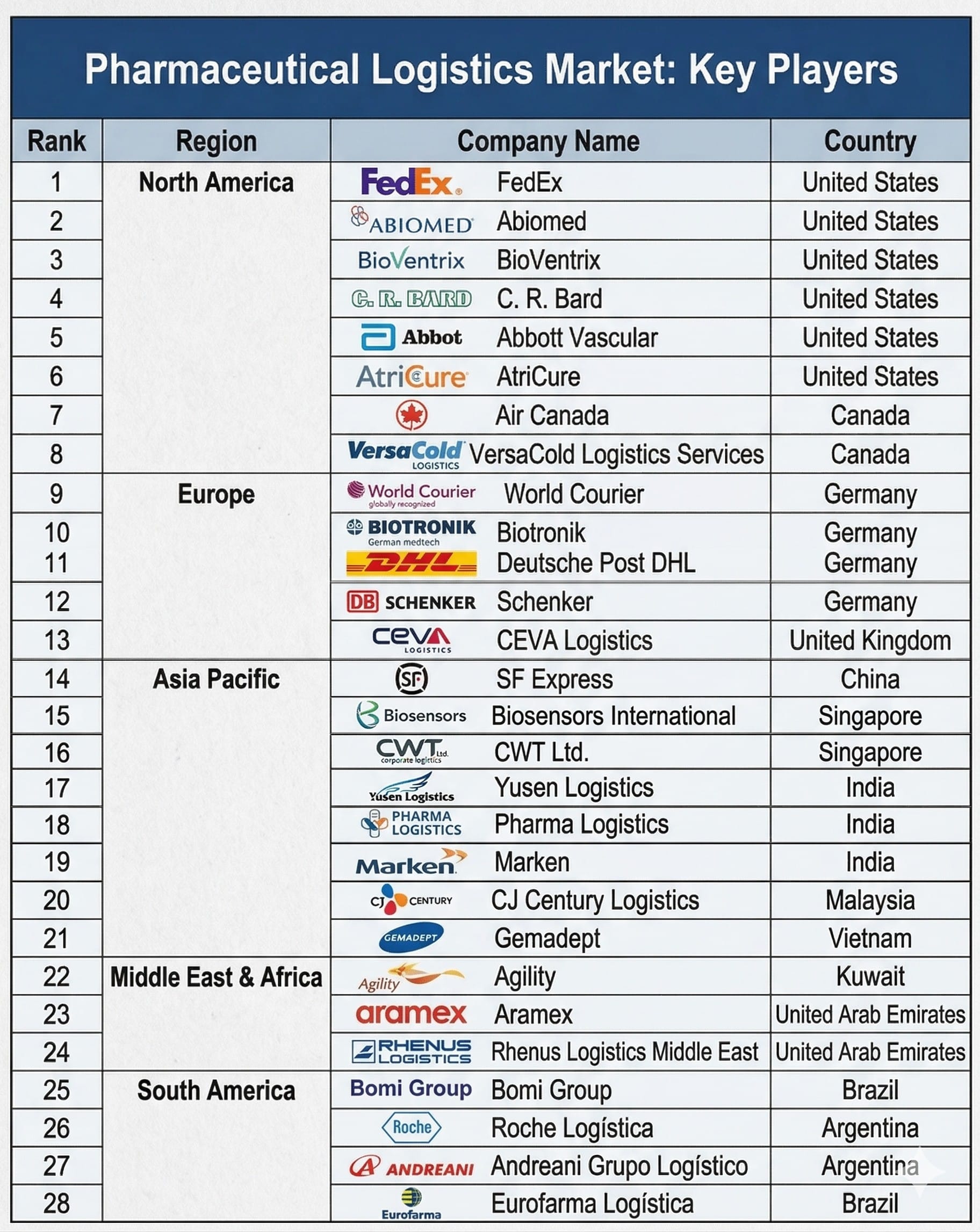
Leading global logistics corporations, specialized couriers, and container leasing innovators operating in this sector include:
- Deutsche Post DHL Group (DHL Global Forwarding / DHL Supply Chain)
- FedEx Corporation
- United Parcel Service, Inc. (UPS Healthcare)
- Kuehne + Nagel International AG
- DB Schenker (Deutsche Bahn AG)
- DSV A/S
- AmerisourceBergen Corporation (Cencora / World Courier)
- McKesson Corporation
- Cardinal Health, Inc.
- Bolloré Logistics
- Agility Logistics
- Nippon Express Holdings, Inc.
- Yusen Logistics Co., Ltd.
- LifeConEx
- Envirotainer AB
- Cryoport, Inc.
- CSafe Global
Leading market players maintain strong positions by securing formal quality accreditations, such as IATA CEIV Pharma certifications, and maintaining dedicated life sciences quality assurance teams. Leading providers are moving past basic spot-market shipping services to offer comprehensive, end-to-end supply chain management contracts. These multi-year service agreements encompass clinical trial packaging, order fulfillment, regulatory customs management, reverse logistics for product returns, and integrated digital tracking platforms that provide pharmaceutical manufacturers with centralized, real-time shipment monitoring across their entire product portfolio.
Strategic Roadmap: Core Decisions for Life Sciences Executives and Logistics Leaders
To navigate shifting regulatory requirements, rising biopharmaceutical complexity, and ongoing supply chain challenges over the coming decade, organizational leadership must implement four critical strategic decisions:
1. Shift from Reactive Cold-Chain Management to Predictive Telematics
Pharmaceutical supply chain executives must retire passive, unmonitored shipping methods for sensitive biologics. Relying on simple historical data loggers that are read only after a shipment arrives leaves products vulnerable to uncorrectable thermal damage during transit. Leadership should invest in active, IoT-enabled tracking devices that stream real-time temperature, location, and environmental data to centralized command centers. Using predictive AI models, logistics teams can anticipate potential flight delays, customs clearance bottlenecks, or weather disruptions, rerouting shipments or dispatching local emergency response teams to replenish dry ice or provide backup refrigeration before cargo suffers thermal damage.
2. Accelerate End-to-End Serialization and Data Integration
With drug traceability regulations maturing globally, pharmaceutical companies must eliminate internal data silos between manufacturing execution systems, enterprise resource planning (ERP) platforms, and third-party logistics software. Organizations should build open, API-driven data architectures that track serialized medicine packs seamlessly across every transit handoff. Ensuring complete, end-to-end digital traceability protects brand equity, streamlines product recalls, and prevents counterfeit products from entering legitimate commercial distribution channels.
3. Build Climate-Resilient and Sustainable Logistics Networks
As environmental reporting requirements and Scope 3 greenhouse gas reduction goals expand across the corporate life sciences sector, logistics directors must balance temperature protection with environmental responsibility. Organizations should phase out single-use expanded polystyrene (EPS) foam shipping boxes in favor of circular, returnable, and reusable vacuum-insulated packaging (VIP) containers. Furthermore, logistics managers should work closely with transport carriers to explore carbon-efficient multimodal shipping routes—such as shifting non-urgent biological cargo from air freight to advanced, continuous-monitoring refrigerated ocean containers—to reduce distribution emissions while maintaining strict thermal control.
4. Establish Long-Term Strategic 3PL and 4PL Risk-Sharing Partnerships
Pharmaceutical enterprises must move away from short-term, spot-market freight vendor relationships in favor of integrated strategic partnerships. Managing complex, multi-temperature pharmaceutical distribution requires deep collaboration, mutual investment in validated cold storage facilities, and shared accountability. Formulating clear service level agreements (SLAs) with established life sciences 3PL and 4PL providers allows manufacturers to leverage shared cold-chain infrastructure, navigate local regulatory landscapes, and scale distribution operations efficiently into emerging international markets.
Future Business Direction: The Autonomous, Ultra-Cold Distribution Ecosystem
Looking forward toward 2034 and beyond, the pharmaceutical logistics sector will evolve from an operationally intensive, human-managed shipping trade into an autonomous, data-driven distribution ecosystem. The convergence of artificial intelligence, automated robotics, and specialized cold-chain engineering will redefine how life-saving medicines move across the globe.
In the future healthcare distribution landscape, automated guided vehicles (AGVs) and autonomous robotic systems will manage high-density cryogenic storage facilities without human workers needing to enter hazardous freezing environments. As personalized mRNA cancer vaccines and individualized cell therapies become mainstream medical treatments, point-to-point micro-logistics networks will expand. Autonomous medical delivery drones and smart temperature-controlled courier pods will transport individually tailored therapies directly from regional bioprinting and cell manufacturing facilities to hospital surgical suites within hours of synthesis.
Furthermore, machine learning algorithms will continuously analyze global shipping patterns, historical weather trends, customs clearance intervals, and live airline flight performance to optimize distribution routes autonomously. If an international transport corridor becomes compromised by localized political unrest or severe climate events, smart logistics platforms will re-allocate pharmaceutical shipments dynamically across alternate carrier networks, reserving specialized cold-storage capacity along backup routes automatically.
By safeguarding delicate biopharmaceuticals, eliminating distribution inefficiencies, and ensuring that life-saving therapeutic innovations reach patients securely and reliably, the pharmaceutical logistics market has cemented its position as an essential pillar of global healthcare and modern biopharmaceutical commerce.
For full access to the comprehensive strategic report, visit: https://www.maximizemarketresearch.com/market-report/global-pharmaceutical-logistics-market/108428/
About Maximize Market Research
Maximize Market Research publishes sector forecasts, competitive analysis, and consulting insight for teams evaluating demand, competition, pricing, and growth strategy across high-value industries. By combining rigorous field investigations, primary stakeholder interviews, and advanced econometric modeling, Maximize Market Research equips corporate executives, institutional investors, and strategic planners with clear market intelligence to inform high-stakes business decisions.
Corporate Headquarters
MAXIMIZE MARKET RESEARCH PVT. LTD.
2nd Floor, Navale IT Park Phase 3,
Pune Banglore Highway, Narhe,
Pune, Maharashtra 411041, India
Phone: +91 9607365656
Email: sales@maximizemarketresearch.com