Global Industrial Automation Market Analysis: Edge AI & Cobot Demand Soars
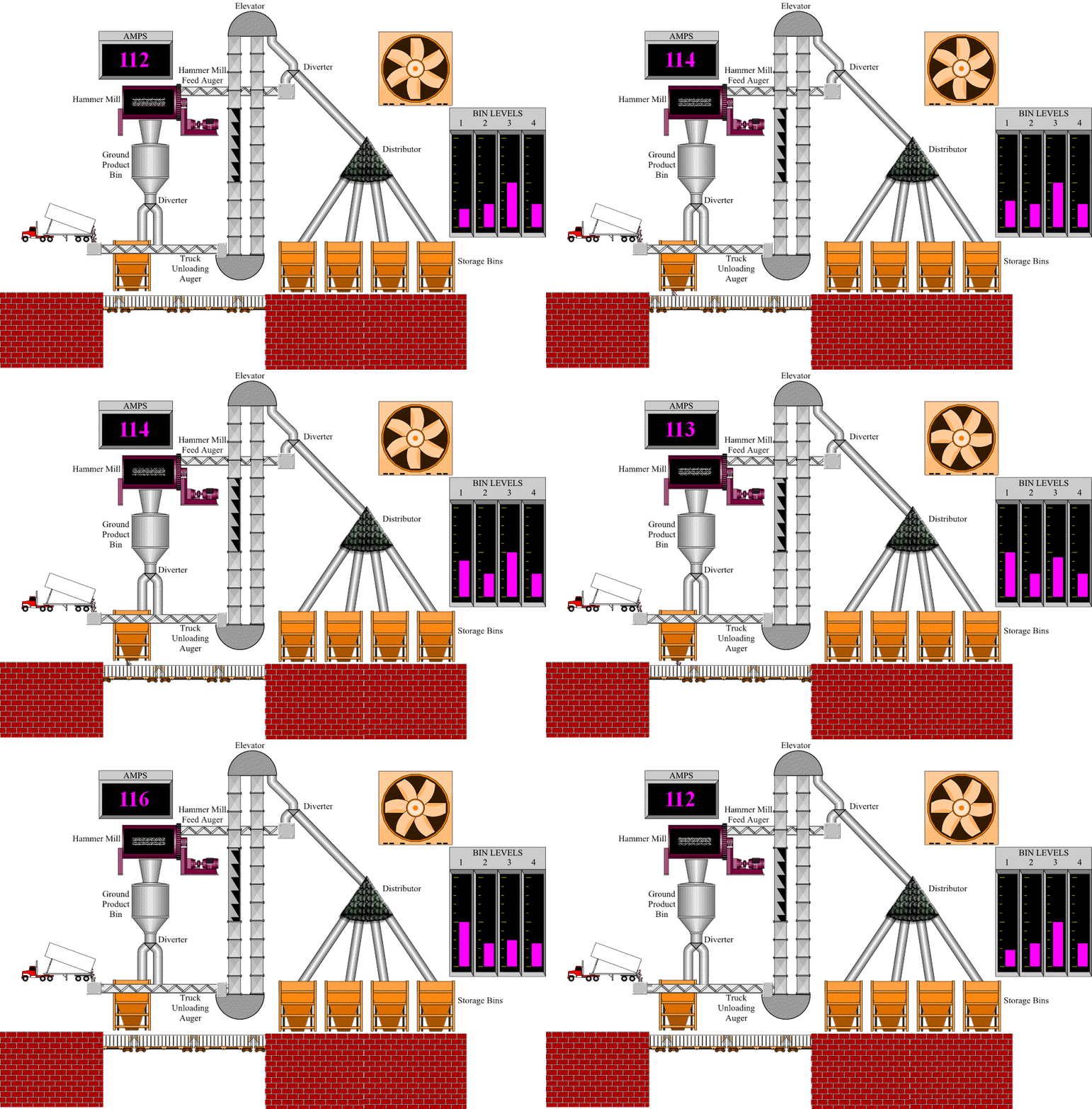
Global Industrial Automation Market Accelerates Toward Significant Expansion, Fueled by Industry 4.0 Adoption, Smart Robotics, and Edge Computing Convergence
Maximize Market Research, a global business intelligence and strategic consulting firm, has released its comprehensive market evaluation report titled "Global Industrial Automation Market: Industry Structure Analysis, Tech Evolution, Regional Growth Pathways, and Long-Term Forecast."
According to the report, the global industrial automation market is undergoing a structural transformation. Driven by the widespread adoption of smart factory architectures, artificial intelligence, edge computing, industrial robotics, and real-time operational technology (OT) networks, the industry is experiencing sustained growth across discrete and process manufacturing sectors globally.
As manufacturers face persistent skilled labor shortages, rising energy costs, and stringent supply chain resilience requirements, industrial automation has transitioned from an operational option into a core strategic imperative for modern industrial enterprises.
𝐃𝐨𝐰𝐧𝐥𝐨𝐚𝐝 𝐏𝐃𝐅 𝐁𝐫𝐨𝐜𝐡𝐮𝐫𝐞 @ https://www.maximizemarketresearch.com/request-sample/39668/
Executive Summary and Strategic Market Vision
Industrial automation represents the integration of advanced hardware systems, control architectures, and software intelligence to operate manufacturing processes with optimized human intervention. By unifying Programmable Logic Controllers (PLCs), Distributed Control Systems (DCS), Supervisory Control and Data Acquisition (SCADA) platforms, industrial sensors, and collaborative robotics (cobots), industrial facilities achieve higher output precision, lower material waste, and enhanced worker safety.
The global manufacturing sector is entering the era of software-defined manufacturing. Legacy, air-gapped industrial facilities are rapidly upgrading into interconnected cyber-physical ecosystems. Through the convergence of 5G connectivity, digital twin modeling, predictive maintenance analytics, and cloud-managed automation platforms, industrial automation enables real-time operational visibility from shop floor sensors to enterprise resource planning (ERP) suites.
This ongoing shift allows industrial operators to move beyond rigid, mass-production assembly lines toward flexible, batch-of-one manufacturing cells capable of dynamically reconfiguring workflows based on real-time market demand.
Primary Market Drivers Elevating Global Demand
- Widespread Migration Toward Smart Factories and Industry 4.0Global manufacturers are modernizing production infrastructure to build resilient, data-driven operational frameworks. Integrating IoT-enabled sensors and automated control loops allows industrial facilities to monitor asset health continuously, prevent unscheduled downtime, and optimize overall equipment effectiveness (OEE).
- Integration of AI, Edge Computing, and Machine VisionThe incorporation of artificial intelligence and edge computing directly into field controllers allows sub-millisecond automated decision-making on the plant floor. AI-driven machine vision systems automate high-speed quality inspection, defect detection, and precise robotic assembly, significantly raising quality standards in semiconductor, automotive, and electronics manufacturing.
- Demographic Shifts and Skilled Labor DeficitsManufacturing hubs across North America, Europe, and Asia face long-term structural labor shortages. Automated material handling systems, autonomous mobile robots (AMRs), and collaborative robots are filling crucial operational gaps, performing repetitive, ergonomically strain-heavy, or hazardous tasks without sacrificing plant throughput.
- Global Industrial Reshoring and Sustainability MandatesGovernment incentives aimed at semiconductor reshoring, battery gigafactory creation, and local supply chain security are driving substantial greenfield factory construction. Simultaneously, strict corporate sustainability goals and energy management regulations require automated process loops to reduce energy consumption and minimize industrial emissions.
Market Restraints and Operational Challenges
While industry momentum remains robust, industrial automation suppliers and plant operators must manage key integration hurdles:
- High Initial Capital Outlay: Deploying full-scale automated manufacturing cells, robotics fleets, and enterprise control systems requires substantial upfront capital expenditure, which can lengthen payback horizons for small and mid-sized enterprises (SMEs).
- Cybersecurity Risks in Connected OT Environments: Connecting legacy operational technology to enterprise cloud networks increases vulnerability to industrial cyber threats. Implementing robust zero-trust network architectures, air-gapped security protocols, and encrypted industrial communication channels remains essential.
- Interoperability and Legacy Integration Complexities: Bridging retrofitted legacy machinery with multi-vendor modern control protocols requires custom middleware engineering, extending deployment timelines.
Detailed Market Segmentation Assessment
By Component & Solution
- Industrial Control Systems (SCADA, DCS, PLC): Command a dominant revenue share in the market. PLCs remain the fundamental building block for discrete manufacturing automation, while DCS platforms serve as the operational backbone for continuous process industries such as oil and gas, chemicals, and power generation.
- Industrial Robotics & Field Devices: Represent one of the fastest-growing technology segments. The proliferation of collaborative robots (cobots), 6-axis articulated arms, and autonomous mobile robots (AMRs) in logistics, automotive assembly, and packaging operations is reshaping warehouse and factory workflows.
- Industrial Sensors & Transmitters: Experience fast-paced demand as the primary data-gathering layer for Industry 4.0 systems, detecting pressure, temperature, vibration, and position parameters in real time.
- Industrial Software (MES, PLM, Digital Twins): Demonstrates strong growth as software-defined automation allows manufacturers to run real-time virtual simulations, manage production scheduling, and track material lineage across distributed global operations.
By Automation Type
- Fixed (Hard) Automation: Holds a substantial market share in high-volume, dedicated manufacturing environments, such as continuous automotive stamping and high-speed bottling lines where high throughput and low unit costs are paramount.
- Programmable & Flexible Automation: Capturing accelerated investment as consumer demand cycles shorten. Flexible manufacturing systems enable rapid retooling and product switching without requiring extensive physical assembly line overhauls.
By End-User Industry
- Automotive & Transportation: Accounts for a primary market share, driven by rapid investments in EV battery cell manufacturing, electric powertrain lines, and automated vehicle assembly plants.
- Pharmaceuticals & Life Sciences: Exhibiting rapid growth supported by regulatory serialization mandates, automated sterile cleanroom processing, and continuous pharmaceutical manufacturing setups.
- Semiconductor & Electronics: Demands extreme mechanical precision, cleanroom robotics, and real-time sensor analytics, driving high capital expenditure in advanced automation machinery.
- Chemicals, Energy, and Food & Beverage: Maintain steady long-term demand for automated process safety loops, fluid handling controls, and automated hygienic packaging workflows.
Regional Dynamics and Global Adoption
Asia-Pacific (Market Leader)
The Asia-Pacific region dominates the global industrial automation landscape and is projected to retain its leading position. Massive manufacturing ecosystems, strong government reshoring and automation incentives across China, India, Japan, and South Korea, combined with rapid industrial robot deployments, position APAC as a major innovation hub. High automotive production, expanding electronics assembly, and substantial gigafactory investments bolster regional growth.
North America
North America represents a highly mature, technology-driven market characterized by fast-paced investments in smart factory retrofitting, cloud-connected SCADA platforms, and industrial reshoring initiatives supported by federal infrastructure policies. Strong enterprise demand for advanced robotics, predictive maintenance software, and automated warehousing drives steady revenue creation across the United States and Canada.
Europe
Europe holds a strategic leadership position in advanced industrial control systems and sustainable manufacturing protocols. Anchored by Germany’s Industrie 4.0 framework, European manufacturers emphasize carbon-neutral production, energy-efficient motion control, advanced machine safety standards, and human-robot collaboration across mechanical engineering, automotive, and chemical sectors.
Middle East, Africa, and South America
These regions present lucrative long-term growth opportunities as municipal energy projects, mining automation, desalination facilities, and regional food processing plants upgrade legacy control systems to modern automated architectures.
Competitive Landscape and Corporate Dynamics
The global industrial automation market features a mix of multinational engineering conglomerates, specialized robotics providers, and agile software developers. Key industry players are focusing on open automation standards, cloud-edge integration, strategic technology acquisitions, and expanding localized engineering support networks.
Leading Industry Leaders Profiled in the Report Include:
- Siemens AG (Germany)
- ABB Ltd. (Switzerland)
- Schneider Electric SE (France)
- Rockwell Automation, Inc. (USA)
- Emerson Electric Co. (USA)
- Honeywell International Inc. (USA)
- FANUC Corporation (Japan)
- Yaskawa Electric Corporation (Japan)
- Mitsubishi Electric Corporation (Japan)
- Omron Corporation (Japan)
Strategic Industry Developments:
Major automation providers are transitioning toward universal, software-centric control architectures based on open protocols (such as IEC 61499). These developments decouple industrial software from proprietary hardware, enabling plant engineers to update control algorithms, integrate third-party AI models, and scale smart factory applications with unprecedented operational flexibility.
Future Business Roles and Strategic Recommendations
To capture emerging opportunities and build long-term competitive advantage in the industrial automation landscape, technology vendors and manufacturing executives should implement the following strategic steps:
- Offer Automation-as-a-Service (AaaS) for SMEs: Automation vendors should develop flexible subscription models and cloud-managed hardware leasing frameworks, lowering the upfront capital entry barrier for small and mid-sized manufacturers seeking robot deployments.
- Prioritize Open Control Protocols and Cybersecurity-by-Design: Engineering teams must design control hardware and software that support open vendor-interoperable standards while embedding hardware-level security modules to protect industrial networks from cyber risks.
- Expand Digital Twin and Predictive Asset Capabilities: Software developers should integrate digital twin simulation tools into standard SCADA and MES packages, allowing operators to model line changes, optimize energy consumption, and run predictive maintenance prior to physical implementation.
- Target the Global Electrification and Energy Transition Market: Suppliers should tailor specialized automation suites for high-growth industrial verticals—such as lithium-ion battery production, green hydrogen processing, and solar cell manufacturing—where extreme process precision is mandatory.
Essential Insights Covered in the Full Market Report
The comprehensive study published by Maximize Market Research equips industrial executives, technology strategists, and institutional investors with actionable, data-backed market analysis:
- Comprehensive global, regional, and country-level market evaluations and long-term revenue projections.
- Granular segment breakdowns across Components, Automation Types, End-User Industries, and Deployment Modes.
- Strategic analytical frameworks including Porter’s Five Forces, PESTEL analysis, Value Chain mappings, and SWOT assessments.
- Complete competitive benchmarking, market share distribution, product portfolio analyses, and strategic merger/acquisition mappings.
For full access to the comprehensive strategic report, visit: https://www.maximizemarketresearch.com/market-report/industrial-automation-market/39668/
About Maximize Market Research
Maximize Market Research publishes sector forecasts, competitive analysis, and consulting insight for teams evaluating demand, competition, pricing, and growth strategy across high-value industries.
Operating at the intersection of industrial technology, software engineering, and strategic business consulting, Maximize Market Research delivers customized market intelligence reports and strategic consulting services across diverse global sectors, including Industrial Automation, Semiconductors, Automotive, Electronics, Energy, Healthcare, and Information Technology. By pairing primary field research with sophisticated data models, the firm enables corporate decision-makers, venture capitalists, and technology strategists to identify untapped commercial opportunities, manage market risk, and drive sustainable corporate growth.
Contact Information and Corporate Details
MAXIMIZE MARKET RESEARCH PVT. LTD.
2nd Floor, Navale IT Park Phase 3,
Pune-Bangalore Highway, Narhe,
Pune, Maharashtra 411041, India
Phone: +91 9607365656 / +1 (800) 501-9878
Email: sales@maximizemarketresearch.com
Website: www.maximizemarketresearch.com