Cloud Data Security Market: The Rise of the Business Risk Architect in 2026
The Sovereignty of Trust: A Visionary Blueprint for the Cloud Data Security Market (2024–2030)
In the current American economic landscape, "The Cloud" is no longer a destination; it is the oxygen of the enterprise. However, as US businesses migrate their most sensitive intellectual property to distributed environments, a paradox has emerged: the very technology that enables infinite scalability has also created an infinite attack surface.
The Cloud Data Security Market is at a historic inflection point. We are moving away from the "Fortress Mentality"—where security was a wall built around a perimeter—toward Data-Centric Sovereignty. This review explores the market’s evolution, the strategic shifts required by US leaders, and a human-centric vision for a future where security is not a barrier to innovation, but its primary catalyst.
Download PDF Brochure @ https://www.maximizemarketresearch.com/request-sample/190307/
1. Market Overview: The US Command of the Digital Frontier
The global cloud data security market is projected to witness an explosive CAGR of approximately 24.5% through 2030. While the global momentum is undeniable, the United States remains the primary architect of this growth.
The Economic Engines
In the USA, the market is driven by three distinct forces:
- The Multi-Cloud Reality: Over 85% of US enterprises now operate on a combination of AWS, Azure, and Google Cloud. This fragmentation creates "visibility gaps" that only advanced cloud security platforms can bridge.
- The Regulatory Hammer: With the evolution of the California Privacy Rights Act (CPRA) and emerging federal-level discussions on data privacy, the cost of "non-compliance" has officially surpassed the cost of "premium security."
- The Ransomware Epidemic: As high-profile US infrastructure faces constant threats, cloud data security has shifted from an IT line item to a National Security priority.
By 2030, the US market share is expected to dominate, not just in consumption, but in the innovation of SaaS-based security solutions that offer real-time, automated threat mitigation.
2. A New Vision: Moving Beyond the "Department of No"
For decades, the security role in American business was perceived as a hindrance—the "Department of No" that slowed down product launches and complicated user experiences.
The New Human Vision: We must reimagine Cloud Data Security as the "Department of Confidence." When a company’s data is truly secure, its developers can experiment faster, its marketing teams can personalize experiences without fear of privacy leaks, and its customers can engage with the brand with total psychological safety.
The "Human-Centric" Security Shift
- User-Experience Focused: Future security tools in the US market will succeed based on their "invisibility." If a security measure disrupts a worker’s flow, they will find a workaround. The vision for 2030 is Frictionless Governance.
- Ethical Data Stewardship: American consumers are increasingly making purchasing decisions based on values. A company that treats data security as a "Human Right" rather than a "Technical Requirement" wins long-term brand loyalty.
3. The Future Business Role: From Protection to Value Creation
The role of security in the future business hierarchy is moving from the basement to the boardroom. The Chief Information Security Officer (CISO) is evolving into a Business Risk Architect.
The Strategic Direction
In the US, the business role of cloud security will focus on three key pillars:
- Resilience over Robustness: It is no longer enough to be "unbreakable." The goal is to be "resilient"—the ability to take a hit, isolate the damage, and continue operations without the customer ever noticing.
- The Security-as-a-Product Model: Forward-thinking US firms are beginning to package their security protocols as a value-add for their own clients. In B2B tech, "Our cloud is more secure than theirs" is becoming the ultimate competitive advantage.
- Supply Chain Integrity: As the US government tightens "Software Bill of Materials" (SBOM) requirements, businesses will play the role of "Gatekeepers," ensuring that every third-party cloud vendor they touch meets the same rigorous security standards.
4. Technological Frontiers: The Engines of the 2030 Market
To achieve this vision, the US market is betting heavily on three transformative technologies.
I. Zero Trust Architecture (ZTA): "Never Trust, Always Verify"
Zero Trust is the most significant paradigm shift in the history of the market. In a cloud-native world, "identity" is the new perimeter. Whether it’s an employee in a Starbucks or an automated bot in a data center, every access request must be authenticated, authorized, and continuously validated.
II. AI-Powered Autonomous Response
Human analysts can no longer keep up with the speed of AI-driven cyberattacks. The US market is pivoting toward Self-Healing Clouds. These systems use machine learning to detect anomalous behavior—such as a database being accessed at 3:00 AM from an unusual IP—and automatically shut down the connection before data exfiltration occurs.
III. Confidential Computing
This is the "Holy Grail" of cloud security. Traditionally, data was encrypted at rest and in transit, but it had to be decrypted to be processed. Confidential Computing allows data to stay encrypted even while it is being used in the CPU. For US healthcare and financial sectors, this is the key to unlocking the power of the cloud without ever exposing raw sensitive data.
5. Strategic Decision-Making: The "Five-Point Framework"
For US executives and stakeholders, the decision to invest in Cloud Data Security must be guided by a clear, decisive framework.
Decision 1: Consolidate the "Security Stack"
The average US enterprise uses between 60 and 80 different security tools. This leads to "Alert Fatigue."
- The Move: Pivot toward Cloud-Native Application Protection Platforms (CNAPP). Consolidate your vendors to gain a "single pane of glass" view of your entire cloud estate.
Decision 2: Invest in "Shift-Left" Security
Don’t wait until software is finished to secure it.
- The Move: Integrate security into the DevOps pipeline (DevSecOps). By finding vulnerabilities during the coding phase, US companies can save millions in post-launch patches and potential breaches.
Decision 3: Prioritize Data Sovereignty
As data flows across borders, the legal complexity increases.
- The Move: Choose cloud providers that offer localized data residency and granular control over where encryption keys are stored (Bring Your Own Key - BYOK).
Decision 4: Redefine the "Cyber-Insurance" Relationship
Insurance premiums in the US are skyrocketing.
- The Move: Use high-end cloud security audits to negotiate lower premiums. Treat your security posture as a financial asset that reduces the cost of risk.
Decision 5: The Talent Pivot
There is a massive shortage of cloud security experts in the USA.
- The Move: Stop looking for "Unicorns" to hire. Invest in AI-augmentation tools that allow your existing IT staff to perform at the level of senior security analysts.
6. Navigating the Challenges: The Roadblocks to Vision
A vision without an acknowledgement of obstacles is merely a dream. The US Cloud Data Security market faces significant headwinds:
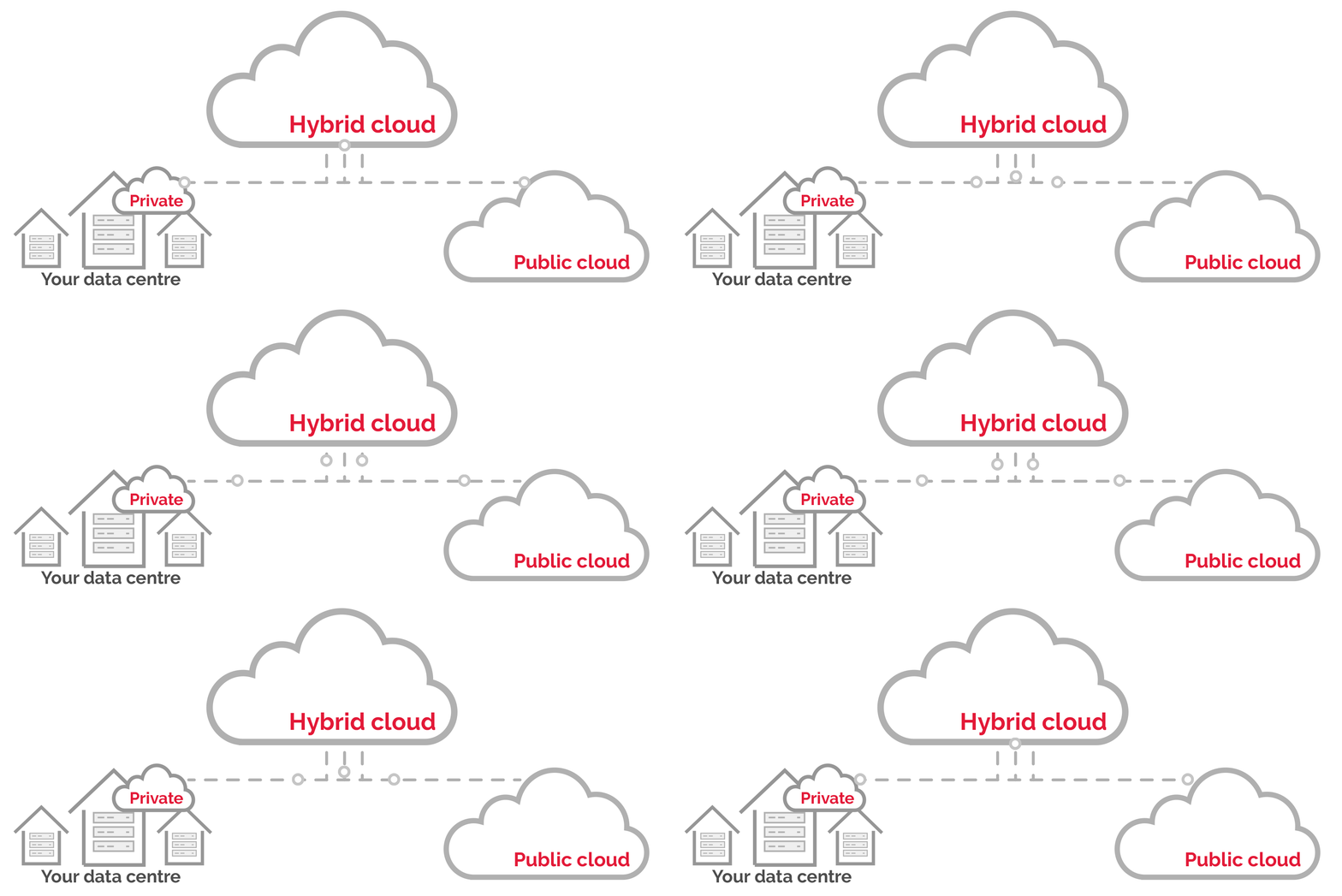
- Complexity of Hybrid Environments: Most US companies can’t go "all-in" on the public cloud overnight. Managing security across on-premise servers and multiple clouds creates a "Hybrid Complexity" that is the #1 source of human error.
- The Sophistication of State-Sponsors: US businesses are primary targets for state-sponsored espionage. This requires a level of defense that goes beyond standard commercial offerings.
- Shadow IT: Employees in the US are highly autonomous. When they use unsanctioned cloud apps (Shadow IT) to get their jobs done, they create invisible "holes" in the corporate data fabric.
For more information, visit: https://www.maximizemarketresearch.com/market-report/cloud-data-security-market/190307/
7. The 2030 Horizon: A Future Built on "Verifiable Integrity"
By 2030, the conversation will shift from "Is our data safe?" to "Is our data integral?"
In a world of deepfakes and AI-generated misinformation, the Cloud Data Security market will expand to include Data Integrity. We will use blockchain-style ledgers in the cloud to prove that a piece of data hasn't been tampered with since its creation.
The Human Conclusion: Imagine a US small business owner who can launch a global e-commerce platform in minutes, knowing that their customers' credit card data and personal identities are protected by an invisible, autonomous, AI-driven shield. Imagine a patient in a rural US hospital whose records are shared instantly with a specialist in NYC, encrypted end-to-end, ensuring life-saving speed without sacrificing privacy.
This is the clear vision: Cloud data security is the foundation of the American Digital Dream. It is the invisible force that allows us to connect, innovate, and lead on the global stage.